
Select the Right Messaging Backbone for an Internal Developer Platform That Ships Several Times a Day
An internal developer platform hides infrastructure complexity behind a thin API, a web portal, and convention. When that platform orchestrates deployments, tests, and environment provisioning, it depends on a message broker to carry commands, events, and state between loosely coupled services. The choice of broker shapes everything from how much Golang or Node.js glue code you write to how the platform degrades when someone pushes a broken Terraform module at 17:45 on a Friday.
Coupling Contracts and the Ownership Boundary
Platform engineering teams rarely own the broker as a raw resource shared freely with every product squad. More often, the platform exposes a small set of opinionated exchange types, routed through a sidecar or a thin client library. The first decision is whether the broker acts as a shared infrastructure component or as an opaque managed service consumed through a platform API.
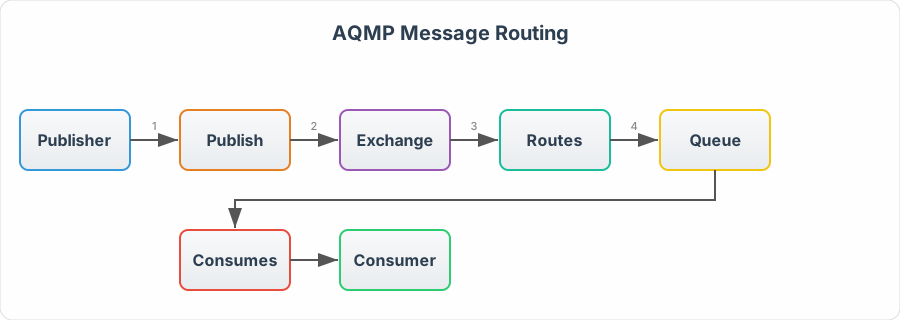
RabbitMQ encourages a shared model where each team declares its own queues and bindings but must respect naming conventions and topic prefixes the platform team enforces. This creates moderate coupling at the integration surface because producers and consumers agree on routing keys that live in the application configuration. The platform team typically operates the cluster, patches it, and triages partition events, so infrastructure ownership stays centralized. Team capability needed is modest: JavaScript backend developers can reason about AMQP 0-9-1 exchanges and queues with minimal training because the mental model maps closely to HTTP request-response, just asynchronous.
NATS, and specifically JetStream, pushes the ownership boundary even further toward the platform. Subject-based addressing lets the platform group consume events via wildcard subscriptions without application teams ever knowing the exact subject topology. Decoupling is higher, but the platform must manage stream retention, consumer offsets, and cluster size more aggressively because the broker is essentially a dumb pipe with durable storage layered on. Teams that treat NATS subjects like a public log discover eventually that a few fast producers can overwhelm slow consumers absent explicit flow control, so the platform engineers must provide a consumption library that bakes in pull semantics.
Kafka inverts the ownership pattern. The platform team owns the cluster, the schema registry, and the governance around topic creation because a topic is a durable log with unbounded retention. Application teams rarely create topics by hand; instead, they submit a pull request that triggers a Terraform module or a Custom Resource Definition. That level of control reduces coupling in the long run but demands that all teams learn offset management, partition assignment, and the consequences of log compaction. Infrastructure automation scripts that talk directly to Kafka must handle group coordinator failures, rebalance storms, and exactly-once semantics that collide with idempotent deployment pipelines. The team capability bar is the highest of the three, but the payoff is a single source of truth that replays an entire deployment’s event history on demand.
System Constraints That Dictate Broker Suitability
Selection pivots on concrete engineering constraints rather than theoretical throughput numbers. The most telling constraint is ordering requirements. If a deployment pipeline must process environment creation, database migration, and health check in strict order, RabbitMQ’s classic queues with a single consumer deliver that without extra code. Partitioned logs can preserve order per partition, but rebalancing between the migration step and the health check step can reorder events unless you pin every correlated event to the same routing key.
Another constraint is the shape of the consumer group. Internal developer platforms typically fan out a single deployment event to many services: the CI listener, the audit logger, the notification service, the status dashboard emitter. RabbitMQ handles fan-out easily through fanout exchanges or topic exchanges with multiple bound queues. NATS broadcasts to all subscribers on a subject by default, so a deployment event reaches all interested consumers with one publish call. Kafka requires explicit consumer groups, and each group gets its own copy of the log. That design is powerful for replay but means the platform must provision consumer group offsets and monitor lag for each service.
Data retention demands drive the decision toward a log-based broker. If the platform must recalculate a deployment success rate from raw events emitted six months ago, Kafka’s infinite retention model on cheap object storage eliminates the need for a separate data warehouse. RabbitMQ queues discard messages after consumption by default; lazy queues with large disk backlogs work for short-term buffering but degrade when millions of messages sit idle. A platform team that needs to answer “what exactly happened during the failed deploy last Tuesday” from the broker alone will pick Kafka or JetStream with a long stream retention policy.
Latency tolerance also matters. A developer clicks “Deploy to staging” and expects a near-instant acknowledgement before the orchestration kicks off. RabbitMQ and NATS acknowledge writes to a quorum in single-digit milliseconds inside the same datacenter. Kafka acks with acks=1 and direct memory writes are similarly fast, but the true asynchronous write path that fans through the page cache adds a few milliseconds of jitter. For a platform that serves an interactive UI, a broker that can synchronously confirm persistence without flushing to disk every time reduces the cognitive gap between click and visible feedback.
Workload Patterns Where Each Broker Delivers
A platform that acts primarily as a job queue with retries, dead-lettering, and time-to-live per message maps directly to RabbitMQ. The exchange-queue-binding model lets platform engineers define a deploy.retry exchange and route messages that hit a x-death header to a separate queue for inspection. JavaScript backend developers build worker services that consume from named queues, scale horizontally by adding more consumers, and rely on RMQ’s automatic request distribution. This pattern works when a single deployment order fans out to a dozen idempotent actions and the platform needs to surgically nack or dead-letter individual steps without pausing the entire pipeline.
When the platform must stitch together a chain of events across multiple teams and time windows, Kafka becomes the system’s central nervous system. A deployment emits a DeploymentRequested event. The image builder picks it up and emits ImageReady. The security scanner consumes that event and publishes ScanPassed. The platform only kicks off a canary analysis when it sees both ImageReady and ScanPassed joined by a correlation ID. Kafka’s durable log allows each service to run at its own cadence and re-consume history during a rollback. A non-obvious architectural advantage: Kafka’s log compaction, when configured for the correlation ID as the message key, lets the platform materialize the latest state of every deployment into a compacted topic. A stateful dashboard reads that compacted topic as a table and renders current environment status without querying a traditional database, cutting infrastructure automation complexity noticeably.
NATS excels when the platform is a collection of lightweight microservices running in edge locations or across developer laptops in local mode. The platform can embed a NATS server in a CLI tool, publish env.provision.laptop subjects, and have a local agent react instantly. Because NATS subjects require no central topic creation, developers prototype a new platform capability by subscribing to a wildcard like deploy.> and iterating without opening a ticket. JetStream adds persistent streaming so the same code works locally with ephemeral storage and in production with file-backed streams. This pattern lowers the developer experience barrier dramatically because the broker fades into the background, a property that a RabbitMQ cluster requiring pre-declared queues cannot replicate.
Operational Realities Beyond Throughput Benchmarks
Throughput is rarely the bottleneck in a platform that deploys a few hundred times per day. The operational cost lies in recoverability, observability, and failure modes. RabbitMQ operates with a battle-tested quorum queue that survives node loss transparently, but recovering a corrupted mnesia database or a split-brain scenario demands a specific sequence of CLI commands that most JavaScript developers will never memorize. The platform team must codify recovery runbooks as infrastructure automation scripts and likely run regular chaos drills to keep the knowledge current.
Kafka’s operational burden concentrates on rebalancing. Adding a new consumer to a group triggers a rebalance that pauses all consumers in that group for tens of seconds in worst-case scenarios. A platform that spins up a new audit service instance during a peak deployment hour can inadvertently stall every other consumer, causing the deployment pipeline to time out. Cooperating rebalance protocols and static group membership mitigate this, but they require configuration the platform team must bake into every client library.
NATS is simpler to operate because the core server is a single binary with no external dependency, but its simpler architecture means fewer built-in safety nets. A misconfigured stream retention policy that discards messages silently can cause a full-stack deployment status dashboard to show stale data for hours. Platform teams often wrap NATS with a thin reconciliation loop that periodically cross-checks stream offsets against a control plane database, adding a component that a Kafka deployment avoids natively.
All three brokers will feature prominently in DevOps tools 2026 because platform engineering is consolidating around GitHub Actions, Argo CD, and Terraform providers for cluster management. The broker that survives daily deployments is the one the platform team can instrument with Prometheus metrics, alert on consumer lag with a threshold that triggers a page, and rebuild from scratch using an infrastructure-as-code repository that stands up the entire cluster and its schemas in under ten minutes.
TL;DR
- The broker’s coupling model determines how much application code the platform team owns. RabbitMQ bakes queuing semantics into client code, NATS hides subject topology behind wildcards, Kafka demands topic governance via infrastructure automation.
- Ordering and fan-out requirements override throughput specs. Strict per-deployment ordering pushes toward RabbitMQ single-consumer queues, while fan-out to many independent services fits NATS broadcast or Kafka consumer groups.
- Data retention shapes the choice. Platforms that need to replay history to recompute state select Kafka or JetStream; platforms that discard messages after processing pick RabbitMQ.
- Latency of synchronous acknowledgements matters for interactive IDP portals, favoring RabbitMQ quorum queues and NATS in-memory acks.
- Kafka’s log compaction can replace a separate state database for deployment tracking, reducing infrastructure automation complexity.
- Operational runbooks differ: RabbitMQ quorum recovery, Kafka rebalance storms, and NATS silent data loss each require specific mitigations encoded as infrastructure-as-code.
Contact BaseStation Private Limited at [email protected] for backend engineering services that keep your deployments boring and predictable.